
Retry strategies
When a handler throws, the message goes back on the queue to be retried. A retry strategy decides how long to wait before each retry. This page covers the default strategy and writing your own.
Waiting between retries helps when messages fail because of race conditions, a service being unavailable, or contention with other messages being handled at the same time.
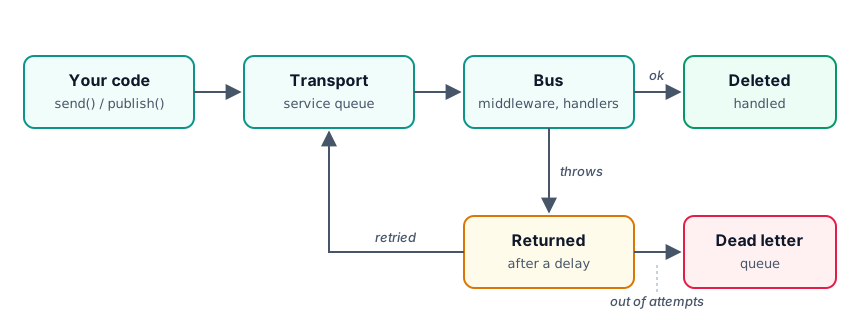
The default strategy
By default the bus uses DefaultRetryStrategy, which increases the delay exponentially with each attempt, from 5 ms to 2.5 hours over the first 10 attempts. Each delay varies randomly by up to 10%, so messages that fail together, such as on a deadlock, don't keep retrying at the same moment.
Pass a strategy to withRetryStrategy() to use a different one:
Bus.configure().withRetryStrategy(new DefaultRetryStrategy())Custom strategies
A retry strategy implements RetryStrategy from @node-ts/bus-core. Its calculateRetryDelay is given how many attempts have failed, starting from 0, and returns how many milliseconds to wait.
const MAX_DELAY_MS: Milliseconds = 60_000

/**
 * Waits one more second for each failed attempt, up to a minute
 */
export class LinearRetryStrategy implements RetryStrategy {
  calculateRetryDelay(currentAttempt: number): Milliseconds {
    return Math.min((currentAttempt + 1) * 1_000, MAX_DELAY_MS)
  }
}

Bus.configure().withRetryStrategy(new LinearRetryStrategy())
When a message runs out of attempts
The retry strategy only decides the delay. How many attempts a message gets before it's moved to the dead letter queue depends on the transport: maxRetries for RabbitMQ and maxReceiveCount for Amazon SQS, both 10 by default.
A handler that knows a message will never succeed can send it straight to the dead letter queue with ctx.failMessage(). ctx.returnMessage() returns it to the queue for a retry without failing the handler.
See also
RetryStrategyandDefaultRetryStrategyin the API reference- Lifecycle hooks, to log failures with
onError